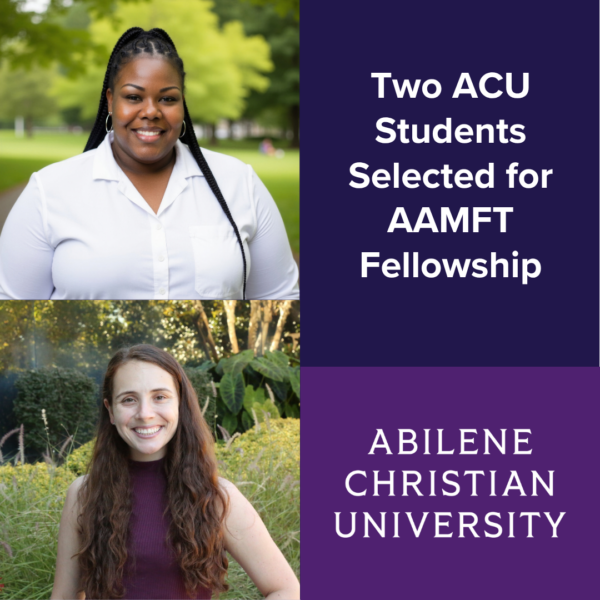
 Two members of Abilene Christian University’s (ACU) online Marriage and Family Therapy (MMFT) program have been selected for the 2026-2027 Foundation for the Advancement of Human Systems (FAHS) Minority Fellowship Program. The FAHS Minority Fellowship Program, overseen by the American Association for Marriage and Family Therapy (AAMFT), is a nationally competitive program that prepares marriage and family therapists to strengthen the behavioral health workforce through advanced training, mentorship and leadership development. Fellows are equipped to expand access to mental health and prevention services for substance abuse in communities across the country.
This fellowship is awarded to only 55 applicants out of the thousands who apply each year. Current online MMFT student Olivia Batshon and 2025 graduate Karen Lewis were selected following a rigorous application process that included academic achievement, professional recommendations and essays outlining their commitment to advancing the marriage and family therapy profession.
A Journey Marked by Perseverance
Olivia Batshon first learned about ACU after receiving an email from Dr. Salkil about the MMFT program. She immediately felt drawn to the program’s mission and curriculum. She applied for the fellowship and was not chosen on her first try. Instead of getting discouraged, Batshon took the opportunity to grow as a student and completely reworked her approach when applying for the fellowship a second time.
“Some of the most impactful things in my life have come to me after the second try,” she explained.
Batshon originally began the MMFT program in 2021, around the time she was planning her wedding, facing major health challenges and working full-time. The combination was overwhelming, and she failed her classes. Instead of viewing that moment as the end of her dream, she took time to focus on her health and reassess her priorities. Three years later, she reapplied to ACU with a detailed academic plan and renewed sense of confidence.
“I had a feeling of not knowing if I had the brain capacity for school,” Batshon shared. “But I had to pursue it because I know this is where I belong.”
On this second try, Batshon completely redesigned her application, became more intentional in preparation and reapplied the following year. She also took the initiative to become more involved with ACU to build connections and motivate herself to continue pursuing her academic and career goals.
Creating a More Representative Workforce
For Karen Lewis, becoming a marriage and family therapist was an intentional career change. After working in human resources recruitment and operating her own business, she began searching for a therapist who reflected her own lived experiences. When that proved to be difficult, Lewis realized the need for greater representation of people of color within the profession. That realization, paired with a longstanding interest in therapy and relationships, inspired her to pursue her MMFT.
“I wanted representation that mattered,” Lewis said. “I wanted someone who understood my demographic and intersectionality.”
ACU’s online program made that transition possible.
The flexibility allowed her to continue working while earning a COAMFTE-accredited degree that would support licensure in many states and provide a strong foundation for future doctoral study. Professionally, Lewis already felt confident entering graduate school. What she sought was a program that would prepare her to make a long-term impact on clients and families.
Today, she primarily works with couples while also supporting individuals navigating relationship challenges. Lewis said she looks forward to the fellowship’s intensive professional development, particularly its advanced training related to substance use and behavioral health, which aligns closely with her passion for relational therapy.
“I’m super excited about the training aspect of it,” she said. “It’s an incredible professional opportunity.”
Preparing Future Leaders in Marriage and Family Therapy
Lewis described the fellowship application process as an extensive national process requiring multiple faculty recommendations, a competitive essay, academic excellence and participation in informational webinars before submitting materials.
Looking back on graduate school, Lewis encourages current students to begin preparing for clinical internships early by intentionally building relationships with potential placement sites. She also emphasizes the importance of creating a dedicated workspace for online learning and staying organized throughout the program.
Batshon offers similar encouragement for prospective students who may be questioning whether they’re ready for graduate school. “You don’t have to be ready to start,” Batshon shared. “You don’t have to have it all figured out before you begin. If it’s something you truly feel called to, then you should do it.”
As Batshon and Lewis prepare to begin the next chapter of their professional journeys, the FAHS Minority Fellowship will provide additional training, mentorship and leadership development that will equip them to expand access to quality behavioral healthcare while serving individuals, couples and families in communities across the country
If you’re interested in a career in Marriage and Family Therapy, but don’t know where to start, visit our website.